
 What are you looking for?
Why Do Cats Purr? 7 Reasons Behind That Familiar Sound
Cats don't only purr when they're happy. Discover why cats purr, what different purrs can mean, and how body language helps you understand what your cat is trying to tell you.
Few sounds are as closely associated with cats as a soft, steady purr.
You might hear it while your cat is curled up beside you, getting scratched under the chin, kneading a favorite blanket, or settling down for a nap.
Most of us naturally assume one thing:
A purring cat is a happy cat.
And very often, that's true.
But purring is more complicated than it seems. Cats can purr for several different reasons, and not every purr means exactly the same thing.
So, why do cats purr?
The answer often depends on what your cat is doing, where they are, and what the rest of their body language is telling you.
How Do Cats Purr?
That familiar rumbling sound is produced while a cat breathes in and out.
Unlike a typical meow, which is more obviously a vocal sound, purring creates a continuous rhythmic vibration.
This is why you can often feel a cat's purr as well as hear it.
Place your hand gently on the chest or neck of a relaxed purring cat and you may notice the soft vibration continuing with almost every breath.
But the interesting question isn't only how cats purr.
It's why they do it.
1. Your Cat Is Happy and Relaxed
Let's start with the most familiar explanation.
Cats commonly purr when they feel comfortable.
You may notice your cat purring while:
Resting beside you
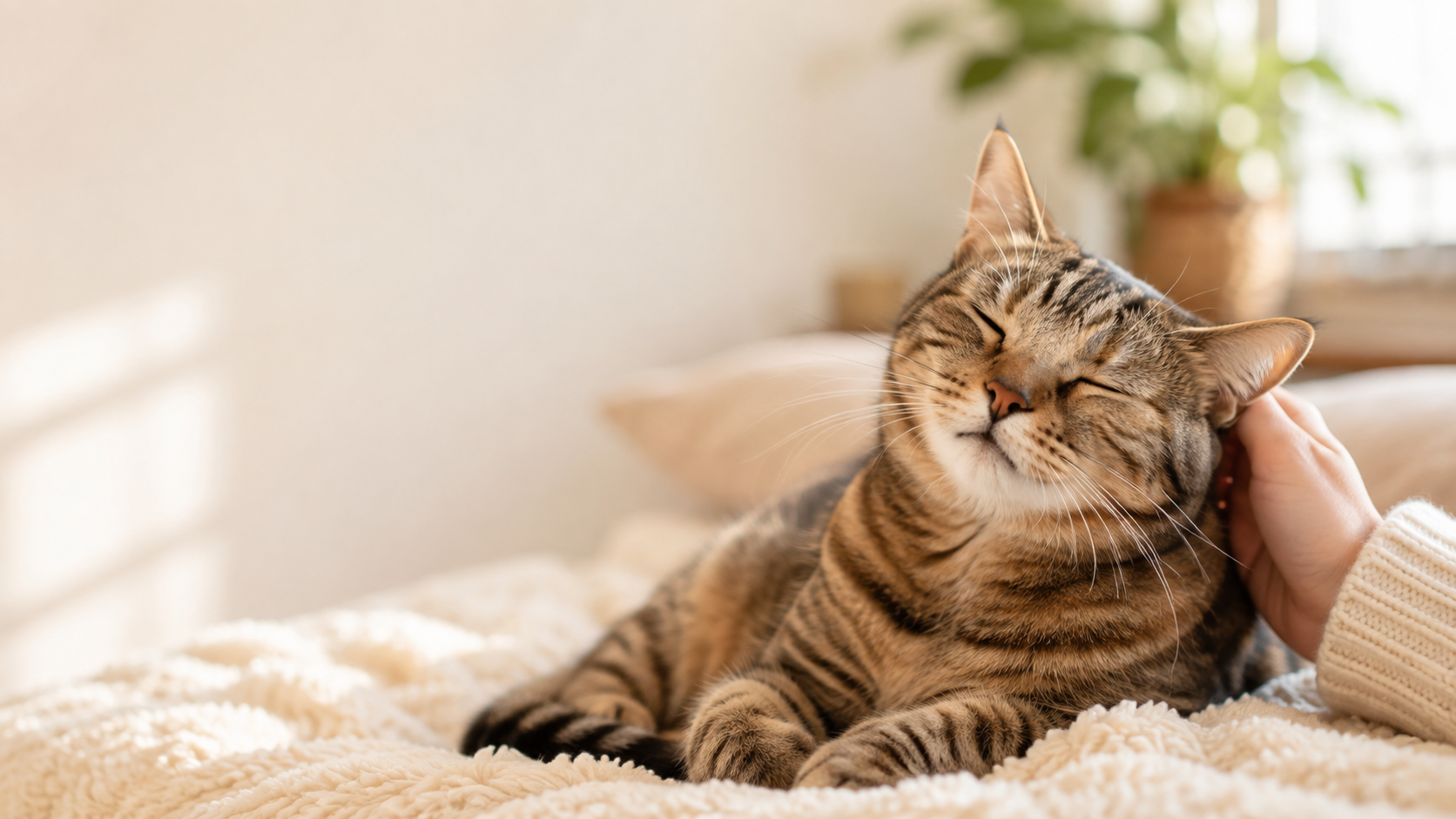
Being gently petted
Lying in a favorite bed
Kneading a blanket
Relaxing in the sun
Getting ready to sleep
In these situations, look at the rest of your cat's body.
A comfortable cat will usually appear loose and relaxed rather than tense.
Their eyes may be partially closed, their paws comfortably tucked underneath them, and their ears positioned naturally.
They might even give you a slow blink.
When all of these signals appear together, the purr probably means exactly what you think it means:
"I'm comfortable here."
2. Your Cat Is Bonding With You
Purring can also be part of the social relationship between cats and the individuals they trust.
Kittens begin communicating with their mother very early in life, and purring is part of that interaction.
As cats grow older, that behavior can continue into their relationships with humans.
Think about when your cat purrs most strongly.
Maybe it happens when they climb onto your lap.
Maybe they start purring the moment you arrive home.
Or perhaps they quietly settle next to you at night and begin their little motor.
When a relaxed cat chooses to stay close to you while purring, it's reasonable to see it as part of your bond.
Not every cat expresses affection in the same way.
Some are extremely cuddly.
Others prefer simply sitting nearby.
And some seem to turn into tiny engines whenever their favorite human enters the room.
3. Your Cat Wants Attention
Cats are excellent at discovering which behaviors get a response from us.
Your cat may learn that purring while rubbing against your leg results in petting.
Or that climbing onto your desk and purring gets you to stop looking at the computer.
Over time, a cat can associate certain behaviors with receiving attention.
You might notice this combination:
Purring + staring at you + rubbing against you + following you.
At that point, your cat may not be subtly communicating anymore.
They may have a very clear request.
"Excuse me. I require attention."
If your cat regularly does this, try responding with positive interaction such as petting, grooming, or a short play session when appropriate.
4. Your Cat Is Asking for Something
Attention isn't always the final goal.
Sometimes your cat wants something specific.
Food is an obvious example.
Cats quickly learn household routines.
They know when breakfast normally happens.
They know which cupboard contains the treats.
And somehow they often know you're five minutes late.
A cat may approach you, vocalize, rub against you, or purr while trying to encourage you toward whatever they want.
That doesn't necessarily mean every purr translates to "feed me."
Instead, look at the entire situation.
If your cat is standing next to an empty bowl while looking between you and the bowl, the mystery probably isn't very difficult to solve.
5. Your Cat May Be Calming Themselves
This is where purring becomes more interesting.
Cats don't only purr during obviously pleasant moments.
Some cats also purr when they're uncomfortable, anxious, or dealing with a stressful environment.
For example, a cat may purr during a veterinary visit even though their body language clearly shows they aren't relaxing at a luxury spa.
In situations like these, purring may be associated with self-soothing.
That's why purring alone should never be used as the only measure of a cat's emotional state.
Look at everything else.
Are their ears relaxed or flattened?
Is their body loose or tightly crouched?
Are their pupils unusually large?
Are they hiding?
Are they attempting to escape?
Context changes the meaning.
6. Kittens Use Purring to Communicate
Purring starts surprisingly early in a cat's life.
Young kittens use close-range communication with their mother while nursing and resting together.
At this stage, purring can be part of the communication that occurs between a mother cat and her kittens.
This early association may help explain why adult cats often purr during moments involving comfort, warmth, security, and close physical contact.
Those cozy moments on your lap may be very different from kittenhood, but some of the emotional associations can remain.
It also explains why purring feels like such an intimate form of cat communication.
It's usually something you hear when you're relatively close.
7. Sometimes Purring Can Happen When a Cat Doesn't Feel Well
This is the part every cat parent should know.
A cat that is purring isn't automatically a cat that is feeling perfectly healthy.
Cats may sometimes purr while experiencing discomfort, stress, or illness.
That doesn't mean you should panic whenever your cat purrs.
A relaxed cat peacefully purring on the sofa probably isn't giving you an emergency signal.
Instead, pay attention to changes from your cat's normal behavior.
Consider contacting a veterinarian if unusual or increased purring appears alongside changes such as:
Reduced appetite
Hiding more than usual
Difficulty moving
Unusual breathing
Changes in litter box habits
Sudden aggression or withdrawal
Significant changes in activity
Signs of discomfort
You know your cat's normal routine better than anyone.
A noticeable change can sometimes tell you more than any individual sound.
Why Does My Cat Purr When I Pet Them?
This is one of the nicest situations to interpret.
If your cat approaches voluntarily, has relaxed body language, and begins purring while you gently pet them, they're most likely enjoying the interaction.
But cats can also become overstimulated.
A cat may enjoy petting initially and decide they've had enough a few moments later.
Watch for signals such as:
Tail flicking
Skin twitching
Ears rotating backward
Suddenly turning toward your hand
Moving away
Swatting or biting
Respecting these signals helps your cat learn that interactions with you are predictable and safe.
The fact that they were purring doesn't mean you have unlimited permission to continue.
Cats are allowed to change their minds too.
Why Does My Cat Purr and Knead at the Same Time?
Purring and kneading frequently appear together because both behaviors are commonly associated with comfort.
Kneading is the rhythmic motion where a cat alternates pressing their front paws into a soft surface.
Some people affectionately call it "making biscuits."
A cat may knead a blanket, a bed, another soft object, or occasionally your stomach—which is adorable until the claws become involved.
When a cat is comfortably kneading while purring, their relaxed behavior usually suggests that they're feeling secure and content.
If those tiny claws hurt, place a thick blanket between yourself and your enthusiastic biscuit maker rather than punishing them for a natural behavior.
Why Does My Cat Purr So Loudly?
Just like people have different voices, cats have different purrs.
Some cats produce a quiet vibration that you can barely hear.
Others sound like a small machine has been turned on inside them.
The volume of your cat's purr can vary depending on the individual cat and situation.
What's more useful than comparing your cat to another cat is learning what is normal for your cat.
If they've always been a loud purrer, that's simply part of who they are.
A sudden major change in vocalization or behavior deserves more attention than whether your cat happens to be louder than another cat.
Do All Cats Purr?
Many domestic cats purr regularly, but not every cat does it in the same way or with the same frequency.
Some cats rarely produce an obvious purr.
Others purr almost every time they're touched.
That variation is completely consistent with something cat owners learn very quickly:
Every cat has their own personality and communication style.
One cat may greet you with loud meows.
Another may rub against your legs.
Another sits silently nearby.
And another starts purring before you've even touched them.
Getting to know those individual habits is one of the most rewarding parts of living with cats.
How Can You Tell What Your Cat's Purr Means?
Don't listen to the purr alone.
Look at the complete picture.
Ask yourself:
Where are they?
Are they peacefully sleeping at home or sitting nervously in a carrier?
What is their body doing?
Loose and relaxed, or tense and crouched?
What happened immediately before the purring started?
Did you begin petting them? Did someone unfamiliar enter the room? Did they just wake up?
Is this normal for them?
Understanding your individual cat's normal behavior makes unusual changes much easier to recognize.
Over time, you begin learning their language.
A Purr Can Mean More Than "I'm Happy"
So, why do cats purr?
Sometimes the answer really is simple.
They're warm.
They're comfortable.
They're sitting beside someone they trust.
And life is good.
But purring can also be part of bonding, communication, attention-seeking, or self-soothing. In some situations, it may even accompany stress or discomfort.
That's why context matters.
At Lylo & Mingming, we think one of the best parts of sharing your life with cats is discovering that every little sound and behavior has its own story.
The more you watch and listen, the easier it becomes to understand what your cat is trying to tell you.
And sometimes that little rumbling motor really does mean:
"I'm happy right here with you."
This article is intended for general educational purposes and is not a substitute for veterinary advice. If your cat develops sudden behavioral changes or signs of illness or pain, contact a veterinarian.
Why Cats Have Such Different Personalities: Understanding What Makes Your Cat Unique
From fearless explorers to quiet observers, every cat has their own way of experiencing the world. Understanding those differences can help you build a stronger, calmer relationship with your cat.
Why Is My Cat Always Meowing for Attention?
Is your cat constantly meowing for your attention? Learn why cats become extra vocal, what they may be trying to tell you, and simple ways to respond without reinforcing unwanted behavior.
Discussion
Questions, cat stories, and friendly thoughts are welcome.
Loading comments…