
 What are you looking for?
When Do Cats Stop Growing? A Complete Kitten Growth Guide
Wondering when your kitten will reach full size? Learn when cats typically stop growing, what affects their adult size, and why some breeds take much longer to mature.

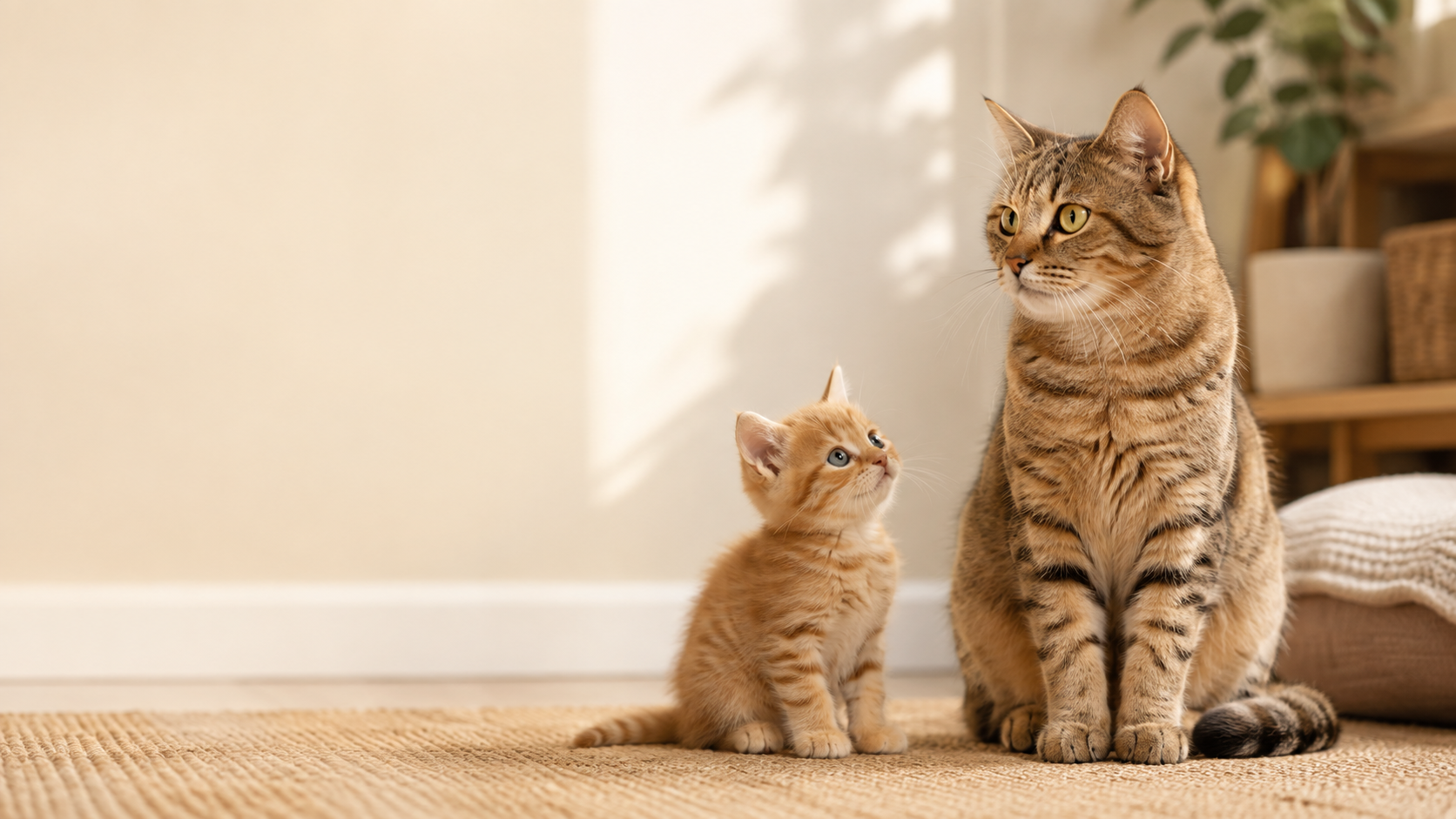
One of the strangest things about bringing home a kitten is how quickly they seem to change.
One week they're tiny enough to curl up in your hands.
A few months later, they're racing through the house with longer legs, a bigger body, and what suddenly looks like an adult cat's face.
So naturally, many cat parents eventually ask:
When do cats stop growing?
For most cats, the biggest period of physical growth happens during their first year. However, reaching adult size isn't always as simple as turning 12 months old.
Some cats continue filling out well into their second year, while large breeds can take several years to reach their full adult size.
Here's what actually happens as a kitten grows.
When Do Cats Stop Growing? The Short Answer
Most domestic cats are close to their adult height and body length by around 12 months old.
However, many cats continue developing and filling out until roughly 12 to 18 months of age.
Breed, genetics, sex, nutrition, and individual development can all influence how quickly a cat matures.
And some larger breeds grow much more slowly.
For example, large cats such as Ragdolls and Maine Coons may continue developing for several years before reaching their final adult size and weight.
So your one-year-old cat might technically look like an adult while still having some growing left to do.
How Fast Do Kittens Grow?
Kitten growth isn't perfectly consistent.
They grow incredibly quickly during the first few months of life and then gradually slow down as they approach adulthood.
A simple way to think about it is that kittens go through several broad stages.
Birth to 8 Weeks: Extremely Fast Development
The first two months of a kitten's life are packed with changes.
Newborn kittens are completely dependent on their mother.
Their eyes are closed at birth, their movements are limited, and they rely on their mother for warmth and nutrition.
Within just a few weeks, that changes dramatically.
They begin:
- Opening their eyes
- Walking
- Exploring
- Playing
- Interacting with littermates
- Eating solid food
By eight weeks old, kittens already look like tiny versions of adult cats.
But physically, they still have a huge amount of growing left to do.
2 to 6 Months: The Big Growth Spurt
This is often the most noticeable growth stage.
Between roughly two and six months, kittens can seem to get bigger almost every week.
Their legs become longer.
Their bodies stretch out.
Their facial features change.
Their coordination improves.
And their energy levels can feel practically unlimited.
This is also why kittens need food specifically formulated for growth.
Their bodies are developing rapidly and require different amounts and proportions of nutrients compared with adult cats.
If you take photos of your kitten every few weeks during this stage, the difference can be surprisingly dramatic.
6 to 12 Months: Growth Begins to Slow
Around six months, many cats still look somewhat kitten-like, but their growth starts becoming less dramatic.
Their adult proportions begin appearing.
The head, chest, legs, and body gradually become more balanced.
You may also notice their behavior beginning to change.
They can still be extremely playful, but they often become more coordinated and confident.
By around their first birthday, many average-sized domestic cats are close to their adult height and length.
But that doesn't necessarily mean their development is finished.
12 to 18 Months: Filling Out
Some cats continue changing after their first birthday.
Instead of becoming noticeably taller or longer, they may begin to develop a more mature adult body shape.
The chest may broaden.
Muscle mass may develop.
The face may appear more mature.
Their overall proportions can change.
This is why a cat at 18 months can sometimes look noticeably different from the same cat at 10 or 12 months.
They didn't necessarily become dramatically taller.
They simply finished filling out.
Large Cat Breeds Can Take Much Longer
Breed makes a big difference.
Many standard domestic cats mature relatively quickly.
Large breeds can be a completely different story.
Some may continue developing for two, three, or even four years.
What About Ragdoll Cats?
Ragdolls are a great example.
They're naturally large cats and tend to mature more slowly than the average domestic cat.
A young Ragdoll might already look large at one year old but still have considerable physical development ahead.
Some Ragdolls don't reach their full adult size and weight until around four years old.
That doesn't mean they're continuously growing taller at the same speed for four years.
Instead, growth gradually slows while their body continues developing, broadening, and filling out.
So if you have a young Ragdoll who still seems a little lanky, that can be perfectly normal.
Large fluffy coats can also make judging body size especially tricky.
What Determines How Big a Cat Will Get?
There's no universal adult size for cats.
Two perfectly healthy cats can reach completely different adult weights and body shapes.
Several factors play a role.
Genetics
Genetics is probably the biggest factor.
If you know the size of a kitten's parents, that can sometimes give you a rough idea of how large the kitten may become.
But it's never a guarantee.
A kitten can inherit different combinations of traits from both parents.
For adopted cats with unknown backgrounds, predicting adult size becomes even harder.
Breed
Different breeds naturally have different body structures.
A Singapura and a Maine Coon are both domestic cats, but their typical adult sizes are very different.
Some breeds are naturally:
- Small and lightweight
- Long and lean
- Compact and muscular
- Large and heavily built
That means comparing your cat's weight with another unrelated cat isn't always useful.
Body condition matters more than simply chasing a specific number on the scale.
Sex
Male cats are often somewhat larger than female cats of the same breed or genetic background.
But there is plenty of individual variation.
A large female can easily be bigger than a smaller male.
Sex gives you a general tendency rather than a rule.
Nutrition
Growing kittens need enough nutrition to support development.
That doesn't mean feeding as much food as possible will create a larger cat.
Overfeeding doesn't make a cat grow beyond their genetic potential.
It can simply lead to excess body fat.
The goal is healthy growth, not maximum weight.
Overall Health
Health issues during kittenhood can sometimes affect development.
Persistent digestive problems, parasites, poor appetite, or other medical conditions may interfere with normal growth.
Regular veterinary checkups during kittenhood help monitor whether development is progressing normally.
How Can You Tell If Your Cat Has Stopped Growing?
There isn't a single obvious moment where a cat suddenly becomes fully grown.
Instead, you'll usually notice their measurements becoming stable.
One easy method is tracking their weight every few weeks or once a month.
You can also occasionally monitor:
- Body length
- Shoulder height
- Chest development
- Overall body proportions
If these remain relatively stable for several months, your cat is probably approaching their adult size.
Photos can also help.
Take a picture from roughly the same angle every month.
Growth that is difficult to notice day-to-day becomes much more obvious when comparing photographs several months apart.
Is My Cat Still Growing or Just Gaining Weight?
This is an important distinction.
Once a cat approaches adulthood, a rising number on the scale doesn't necessarily mean they're still growing.
They may simply be gaining body fat.
A healthy adult cat should have an appropriate body condition rather than being judged only by total weight.
Ideally, you should be able to feel the ribs without needing to press through a thick layer of fat, while the cat should still have appropriate muscle and body coverage.
Because ideal body condition varies between individual cats, your veterinarian can help assess whether your cat's weight is appropriate.
This is especially important for naturally large breeds.
A Ragdoll is supposed to be larger than many domestic cats.
But being a large breed doesn't automatically mean extra weight is healthy.
Do Cats Stop Growing at One Year Old?
Not always.
One year is a useful milestone because many cats are close to adult size at that point.
But development doesn't happen according to an exact birthday.
Some cats may finish growing earlier.
Others may continue filling out until 18 months or beyond.
Large breeds can take substantially longer.
Think of one year as a general transition into young adulthood rather than a guaranteed finish line.
Can You Predict How Big a Kitten Will Become?
You can make an educated guess, but predicting exact adult size is difficult.
Breed gives you one clue.
Parents give you another.
The kitten's current growth pattern can also help.
But mixed-breed cats may carry genetics from cats of very different sizes.
This means the tiny kitten you adopt might become surprisingly large—or remain relatively petite.
And honestly, that's part of the fun.
Watching their adult appearance slowly reveal itself is one of the most interesting parts of raising a kitten.
When Should You Be Concerned About Kitten Growth?
Every kitten develops at a slightly different pace.
Being smaller than another kitten of the same age isn't automatically a problem.
What matters more is whether your kitten is consistently developing and maintaining a healthy body condition.
Talk with your veterinarian if you notice things such as:
- Little or no weight gain during a major growth period
- Sudden weight loss
- Persistent diarrhea or vomiting
- Poor appetite
- Unusually low energy
- Significant changes in eating or drinking
- A noticeably swollen abdomen
- Difficulty walking or moving normally
These signs don't automatically mean there is a growth problem, but they're worth investigating.
When Should Kittens Switch to Adult Food?
Because kitten food is designed for growth, the transition to adult food should generally happen around the time active growth begins slowing.
For many cats, this happens around their first birthday.
But breed and individual development matter.
Large, slow-maturing cats may have different nutritional needs.
Rather than switching purely based on a date, ask your veterinarian when the transition makes sense for your individual cat.
And whenever you change food, transition gradually rather than replacing the entire diet overnight.
Why Does My One-Year-Old Cat Still Look Like a Kitten?
Some cats simply mature slowly.
Their body may already be close to adult size while their face, proportions, coat, or behavior still looks youthful.
Personality can make the effect even stronger.
A playful 18-month-old cat racing around the house at midnight can feel exactly like the tiny kitten you brought home.
Cats don't suddenly become serious adults the moment their bodies finish growing.
Many keep playful kitten-like behavior for years.
And some never seem to grow out of it.
Every Cat Grows at Their Own Pace
So, when do cats stop growing?
For the average domestic cat, most major growth happens during the first year, with some continued development into roughly 12–18 months.
Large breeds can take considerably longer.
Ragdolls, for example, may continue developing until around four years of age.
The important thing isn't whether your cat matches an exact growth chart.
It's whether they're developing steadily, eating appropriately, staying active, and maintaining a healthy body condition.
Take plenty of photos while they're growing.
Because that tiny kitten phase disappears much faster than it feels like it will.
At Lylo & Mingming, we love how every stage seems to reveal a slightly different cat—from awkward kitten legs to the personality and appearance they eventually grow into.
They may stop getting bigger.
But somehow, they never really stop surprising us.
This article is intended for general educational purposes and does not replace advice from your veterinarian. If you have concerns about your kitten's growth, weight, nutrition, or development, speak with a veterinary professional.
Discussion
Questions, cat stories, and friendly thoughts are welcome.
Loading comments…